


The Indian Credit system mobilises deposits from retail depositors and gets funds from the RBI at certain rates, which it then uses to lend to its loan customers and make a profit by charging a slightly higher rate (margin). The difference in these two rates (borrowing and lending) is the bank’s (or NBFC’s) income.
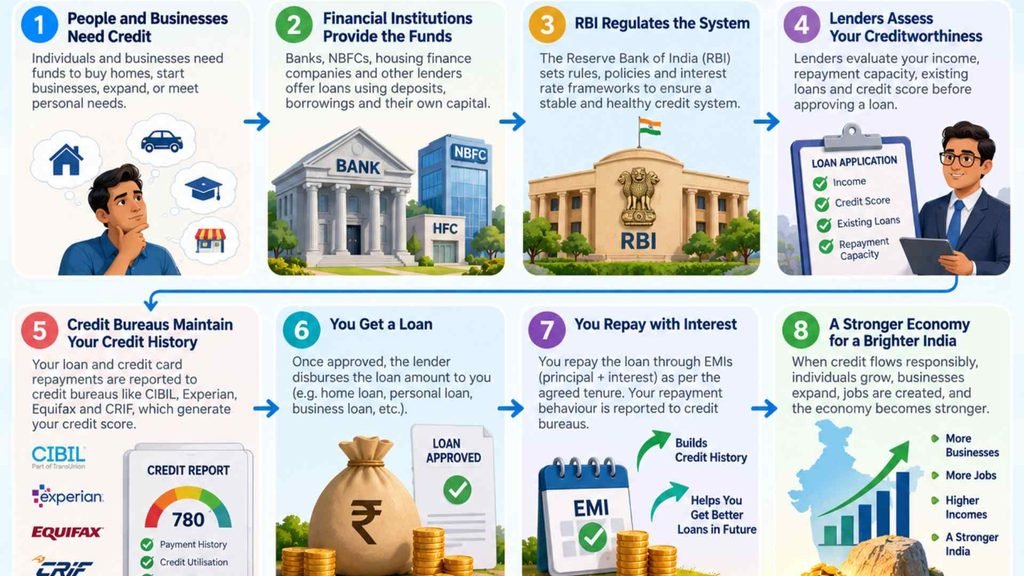
Sources and Demand of Funds in Indian Economy
Sources
Funds in an economy are sourced from multiple sources, a few of them being the Central Bank (RBI), public deposits (retail), foreign investments in local securities, and others. Let us understand each of these sources in brief.
Current Account, Savings Account and Time Deposits
The bulk of funds with commercial banks is mobilized from their depositors via three instruments: current deposits, savings deposits, and time deposits.
- Current deposits are funds in the current accounts of different banks.
- Savings deposits are the funds that people save in their savings accounts.
- Time deposits are recurring and fixed deposits that are kept with the bank for a certain amount of time.
Banks need to maintain at least 15% of their customer deposits as liquidity to prevent any asset-liability mismatch during bank runs.
Central Bank – The Reserve Bank of India
The Reserve Bank acts as a primary funding source for short-term funds for commercial banks. Banks have Government Securities, which are sold to the RBI and then a few weeks or months later are repurchased from the RBI after paying a fixed interest (called the Repo Rate).
Foreign Investment
Foreign investors also invest in fixed-income instruments in India due to their high safety and higher yield than economies like the USA, EU, or Japan.
Consumption/Demand
The mobilized funds are lent to customers through different kinds of loans. Secured loans are less risky for banks and NBFCs but have lower interest rates and hence lower income for banks. Unsecured loans are riskier for banks but offer higher interest rates and hence are more profitable for banks.
Real Estate Loans
These loans are the most secure loans a bank or NBFC can lend because the underlying collateral is the house or property that is being bought. Till the end of the loan period, the property is mortgaged with the bank (i.e., the bank is the real owner), and after the period, the owner of the property gets full rights.
Consumer Loans
Consumer loans are small unsecured loans that people take to buy items such as washing machines, fridges, TVs, mobile phones, and similar other consumer durables. These loans are often unsecured and lent at interest rates ranging from 15% to 18%.
These consumer loans are one of the most important reasons for increased consumer spending in the current decade.
Most consumer loans are taken on credit cards, and therefore, I have not added a separate sector for the same.
Business Loans
Business Loans are given to businesses to help them increase their capacity (capex loans) or to procure more raw materials (working capital loans). These loans are unsecured but are at low interest rates because business loans are only distributed to businesses with a proven track record, with a GST number, and after carefully evaluating their current accounts.
Priority Sector Loans
Priority Sector Loans are those which the Government of India (Finance Ministry) considers to be the top priority for all banks. As a result, most banks are encouraged to lend more to these sectors. Further, banks are often reimbursed via guarantee funds that make these loans less risky for them.
Agri Loans
These are loans provided to farmers via schemes such as the Kisan Credit Card.
Self Help Group Loans
Higher interest loans (around 30% to 35%) are provided to self-help groups (SHG) along with a common savings account so that each group member (women) takes a loan from a formal credit organization to generate some income for their family.
My mother used to be a SHG member, and I have seen her working closely with other women in our locality to strengthen women’s employment. The result was that by the second year, at least 4 women were able to generate income via tailoring.
MSME Loans
These are loans provided to Micro, Small, and Medium Enterprises to help them increase production capacity and generate better employment.
Personal Loans
These are the most profitable yet riskiest loans for a bank because they are unsecured, and banks do not know what the proceeds of these funds would be. These loans are typically given on the basis of the current financial condition of the
Overnight Lending
Overnight lending is a practice in banking where a bank takes a loan from a bigger bank or the RBI to address temporary capital adequacy in return for a small interest.
Inter-Bank Lending
This is a practice where a bank lends to other banks for various reasons, such as a temporary shortfall in cash, recapitalization, and other reasons. They use a certain rate called the Mumbai Inter-Bank Offered Rate (MIBOR).
Who can take a credit/loan?
Banks monitor the customer’s financial credit history via scores such as credit score. Although several other factors affect creditworthiness for different kinds of loans, a credit score is a major one. More on credit score is explained below.
Factors Used to Judge Credit Worthiness
1. Credit Score?
A credit score is a composite score used to ascertain the credit worthiness of an individual. It is calculated using several factors such as income, age, past repayment history, credit limit utilization, employment, and several other factors.
Credit score ranges from 0 to 900 in most cases, depending upon the credit bureau (such as Equifax, CIBIL TransUnion, or Experian).
People with no debt history have a credit score close to 400 or lower, whereas a good credit score is often considered more than 650 and excellent if it exceeds 750.
For example, I have been using credit cards since the age of 23, and over the last 5-6 years I have built a credit score of 780, which helps with easier loan approvals.
The score is critical in determining whether banks should give you a loan or not. The higher the credit score, the more likely a bank is to give you credit or a loan on an unsecured basis.
2. Type of Loan: Secured vs Unsecured
Secured Loans are given to a wide variety of borrowers because they are backed by some collateral, whereas unsecured loans are only offered to people with a higher credit score (say, 650 or more).
3. Loan Purpose
The more productive and secure a loan is, the higher the bank’s intent to lend. House loans, property loans, business loans, and gold loans have the highest security and are lent easily even to people with lower credit scores.
Meanwhile, education and personal loans are riskier and require background checks.
Disclaimer: Das Credit provides information for educational purposes and does not endorse any financial company, asset or form of credit. Readers are advised to consult their financial advisor before taking any decision.
About the Author: Dhirendra Chandra Das is a financial analyst holding an MBA in Finance from Jain University and holds 5 years of professional experience and 11 years of financial market experience.