
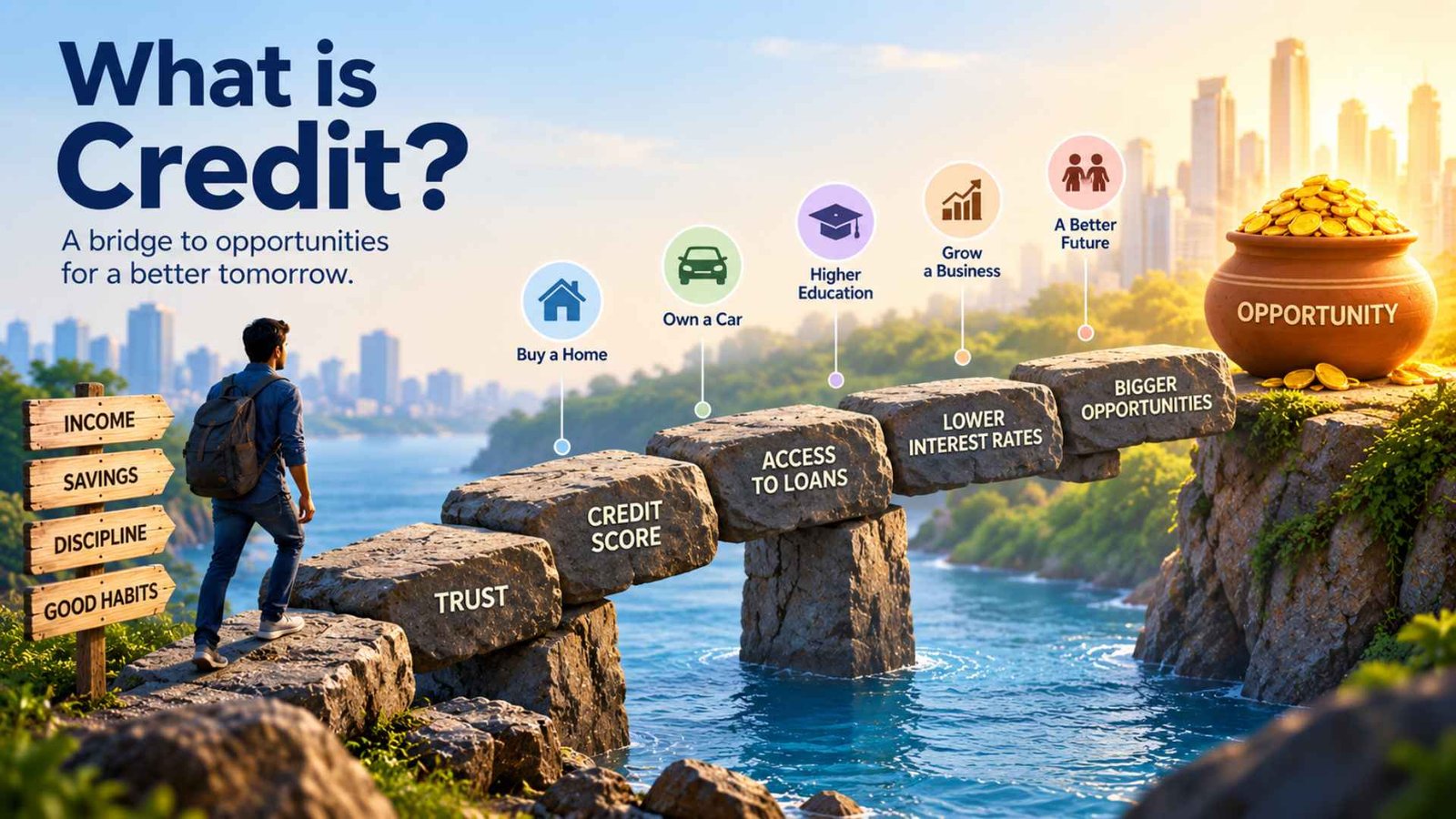

Credit is the money that a borrower takes from the lender in return for a greater payment in the future. Most often, the repayment is fixed at the time of borrowing and at a fixed, agreed-upon rate called the interest rate.
In modern economies, credit forms the lifeline of the financial system because it helps people borrow money for productive work and create assets that can help them earn more.
- For governments, credit is used to create infrastructure that can improve the lives of the people and help them save money or explore greater economic opportunities.
- For individuals, credit helps them get a better education, buy assets, or enhance their purchasing power.
- For companies and institutions, credit helps them grow their business and expand their working capital to be able to produce and sell more goods and services.
Definition
Credit is the creation of debt, that a borrower (such as a person or a company) takes from a lender (such as banks) in return for a greater amount of repayment. It is often issued from a person with surplus money to a person who needs the money.
Interest (often defined in percentage) is charged on the lending amount and is included in the repayment. This interest is the primary motivation why a lender agrees to lend in the first place. Otherwise, a lender will have no reason to lend if they get the exact amount back.
Significance
Credit plays a very important role in an economy. In modern economics, debt is seen as a form of asset generation that creates a new source of income or improves an existing source. It therefore justifies the extra amount that is repaid to the borrower.
For example, I did an MBA in Finance in 2024 taking a personal loan of ₹2,00,000 at a 18% interest rate (zero credit history before and hence the greater loan interest). The MBA helped me get a job of ₹4,80,000 per annum. As a result, I was able to pay back the debt in 6 months while creating a new income source for me.
Similarly, companies take debt to increase their existing production capabilities (called Capital Expansion or Capex). Manufacturers buy additional machines or build new factories whereas traders buy more raw materials. Service providers like me buy more SaaS subscriptions for greater accuracy or hire more people to handle increased workload.
As a result, all of these can now earn greater amount of money than they were doing before.
Good vs Bad Credit
However, there is a caveat. Debt should always be taken when there is an economic opportunity. Individuals should take debt when there is greater job opportunities for higher educated professionals and companies should take debt to meet more demand. Such debt is called productive debt and is considered as good credit.
Economically, bad credit is unproductive credit that is spent on consumer goods. However, there is also an emotional angle to it. If a buyer is able to pay his debt repayments on time, they can use debt to finance their wants. A car loan is a best example of this. Another example is a loan to buy iPhone.
Forms of Credits in a Modern Economy
I have ranked credit sources in a modern economy (taking reference from India in 2026) based on increasing rate of interest.
Bank Loans
Bank Loans form the cheapest form of credit in an economy but only lend to people with good credit score (600 or higher). Typically, their interest rates start as low as 7% for secured loans and can go as high as 18% for unsecured loans like personal loans and credit cards.
For lower credit score, they often ask for collateral such as gold, property, fixed deposits, etc.
Examples of Banks: State Bank of India, HDFC Bank, ICICI Bank, Punjab National Bank, etc.
NBFCs
Non-Banking Financial Corporations or NBFCs are financial companies that cater to customers who cannot get a loan from banking channels. These companies lend at a higher rate of interest because most of their loans are unsecured and they access funds at a higher rate than banks.
Their interest rates start from 12% and can go as high as 30%.
Microfinance companies also fall under this category.
Examples of NBFCs: L&T Finance, Aashirvad Microfinance, etc.
Informal Lending
Informal Lending often involves taking money from moneylenders, relatives, friends and family.
Disclaimer: Das Credit provides information for educational purposes and does not endorse any financial company, asset or form of credit. Readers are advised to consult their financial advisor before taking any decision.
About the Author: Dhirendra Chandra Das is a financial analyst holding an MBA in Finance from Jain University and holds 5 years of professional experience and 11 years of financial market experience.
